Resources
How thick should shelves be? Choosing the right span
A shelf rarely sags on the first day; it sags after a few months under books. Whether it stays straight depends mostly on three things: how far it spans, how thick it is and what it is made of. The chart below shows how far a shelf may span under a typical book load.
In short: Span matters most. For an 11¼ in deep shelf carrying 20 lb of books per foot, a ¾ in particleboard shelf stays barely visibly bent up to about 15 in, Baltic birch plywood up to about 27 in. For longer shelves, a center divider that halves the span helps most.
Updated November 11, 2026 · CuttingFox team
CuttingFox does the math for you: enter your sizes and get a cutting plan, free and with no sign-up.Start planning →
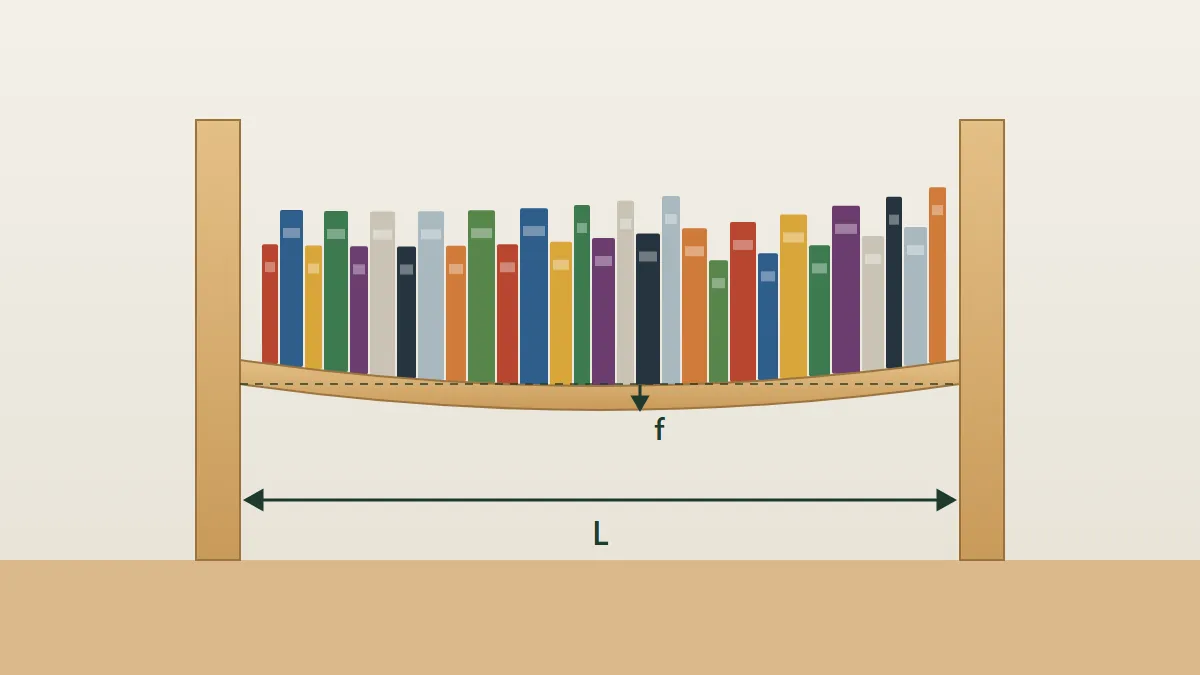
Span beats thickness
Sag grows with the cube of the span at the same total load, and with the fourth power at the same load per foot. A shelf that spans 20 % farther sags about twice as much at the same load per foot. Thickness also counts to the third power, the other way round: a 1 in shelf is more than twice as stiff as a ¾ in shelf.
The material sets the stiffness and how much the shelf creeps under a lasting load. Particleboard and MDF creep much more than plywood or solid wood, so a shelf that looks straight on day one can show a visible bow six months later.
Shelf span chart for books
| Material | ⅝ in | ¾ in | 1 in |
|---|---|---|---|
| Particleboard | 12½ | 15 | 20 |
| MDF | 13¼ | 16 | 21¼ |
| Softwood plywood | 20¼ | 24½ | 32½ |
| Baltic birch plywood | 22½ | 27 | 35¾ |
| Pine, solid | 25 | 30 | 40¼ |
| Oak, solid | 26¼ | 31½ | 42 |
Longest clear span in inches (rounded down) for an 11¼ in deep shelf carrying 20 lb per foot, a well-filled row of books. The limit is 1/600 of the span after months under load, 0.02 in per foot, so the sag is hard to see.
How to read the chart
- The values use typical stiffness figures and the creep factors of Eurocode 5 for dry indoor rooms, so they are guide values. Individual panels can be stiffer or weaker.
- If a visible but acceptable sag is fine (1/300 of the span), spans about 25 % longer work.
- Light loads such as decor or clothes allow much more. Check your own case with the shelf sag calculator.
- A deeper shelf is stiffer in proportion: 15 instead of 11¼ in deep carries a third more at the same sag, but usually also holds more books.
What helps when a shelf is too long
- A center divider or support halves the span. That is almost always the most effective fix.
- Glue a hardwood strip on edge under or in front of the front edge. It works like a small beam and hides the panel edge.
- Fix the shelf to the sides, screwed or in a dado. A shelf held at both ends sags much less than one resting loosely on pins.
- Choose a stiffer material: Baltic birch instead of particleboard at the same thickness.
Doing it in the planner
- Set up the bookshelf with the furniture assistant or enter the shelves yourself.
- If the chart says the span is too long, add a center divider as its own part and shorten the shelves.
- Calculate the plan and check whether thicker stock costs more than one extra divider.