Resources
Plywood, MDF, particleboard or OSB? Sheet goods compared
The right sheet is chosen long before the first cut. The four most common sheet goods differ in stability, edge quality, weight and price, and each behaves differently at the saw.
In short: Plywood is stable, holds screws well and has a nice edge, but costs more. MDF is smooth and paints well, but is heavy and swells when wet. Particleboard is cheap and ready to use when laminated; OSB is strong, cheap and large for subfloors and shop walls.
Updated November 11, 2026 · CuttingFox team
CuttingFox does the math for you: enter your sizes and get a cutting plan, free and with no sign-up.Start planning →
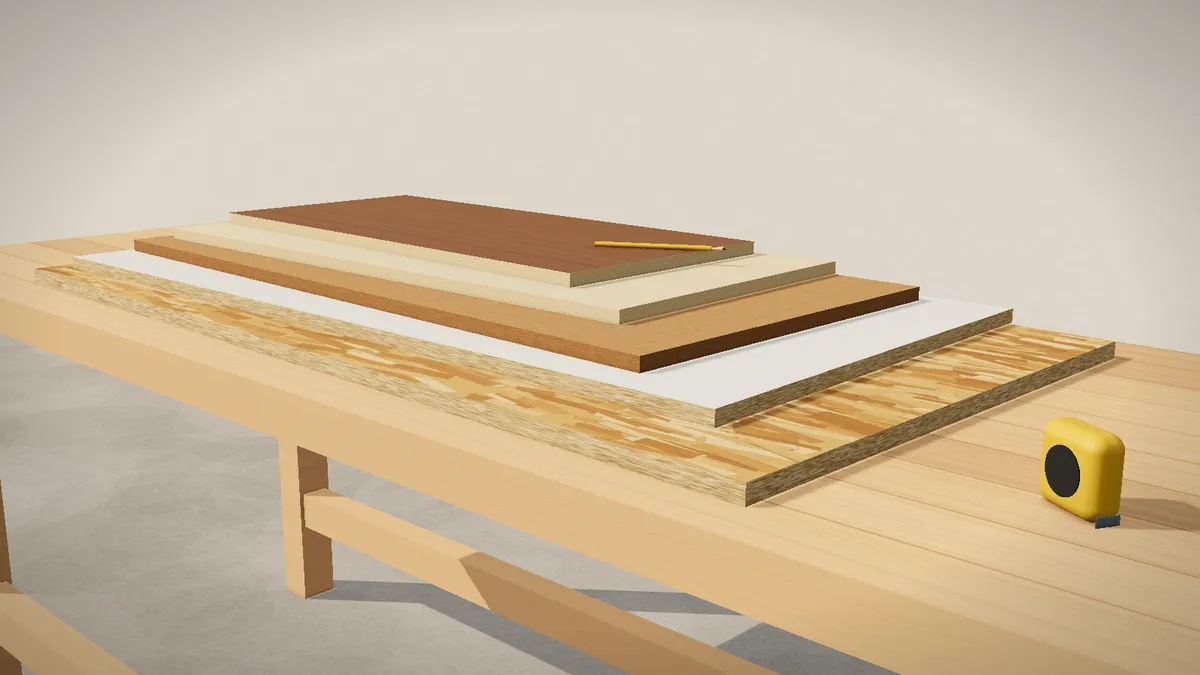
The four classics at a glance
| Material | Strengths | Weaknesses | Typical use |
|---|---|---|---|
| Plywood (hardwood or Baltic birch) | stable, holds screws, attractive edge | more expensive, face veneer can tear out | shelves, furniture, shop cabinets |
| MDF | smooth, uniform, paints well | heavy, swells when wet, fine dust | painted doors, backs, templates |
| Particleboard / melamine | inexpensive, melamine is pre-finished | raw edges, melamine chips easily | cabinet boxes, shelves, closets |
| OSB | strong, cheap, large format | rough surface, uneven factory edges | subfloors, sheathing, shop walls |
What it means for cutting
- Plywood and veneered panels have a visible grain direction. Decide which parts must run with the grain and lock rotation in the planner.
- MDF and particleboard have no grain. Let the planner rotate parts; that often saves a whole sheet.
- Melamine chips on the side where the blade exits. Cut with the show face toward the side where the teeth enter, or tape the cut line.
- OSB rarely has perfectly straight factory edges. Plan a trim cut before cutting parts to size.
Choosing the thickness
For shelves up to about 32 in wide, ¾ in material is common; for heavy loads or longer spans use thicker stock or a center support. Cabinet backs usually get by with ¼ in. Note that ¾ in plywood often measures 23/32 in, so check the real thickness before you calculate dadoes or inside widths.
Tip: plan matching sheets together
If you enter different materials or thicknesses, CuttingFox plans each material group separately. A ¼ in back panel never ends up on a ¾ in sheet by mistake.